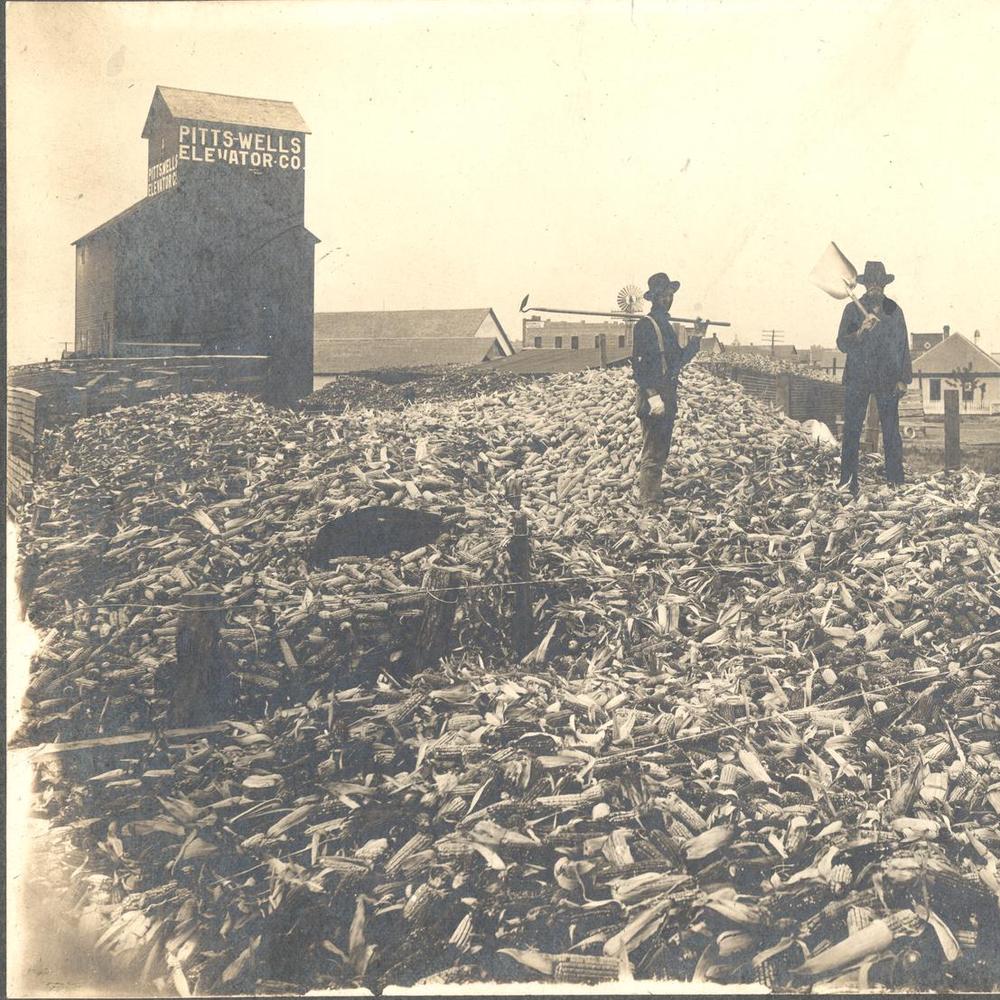
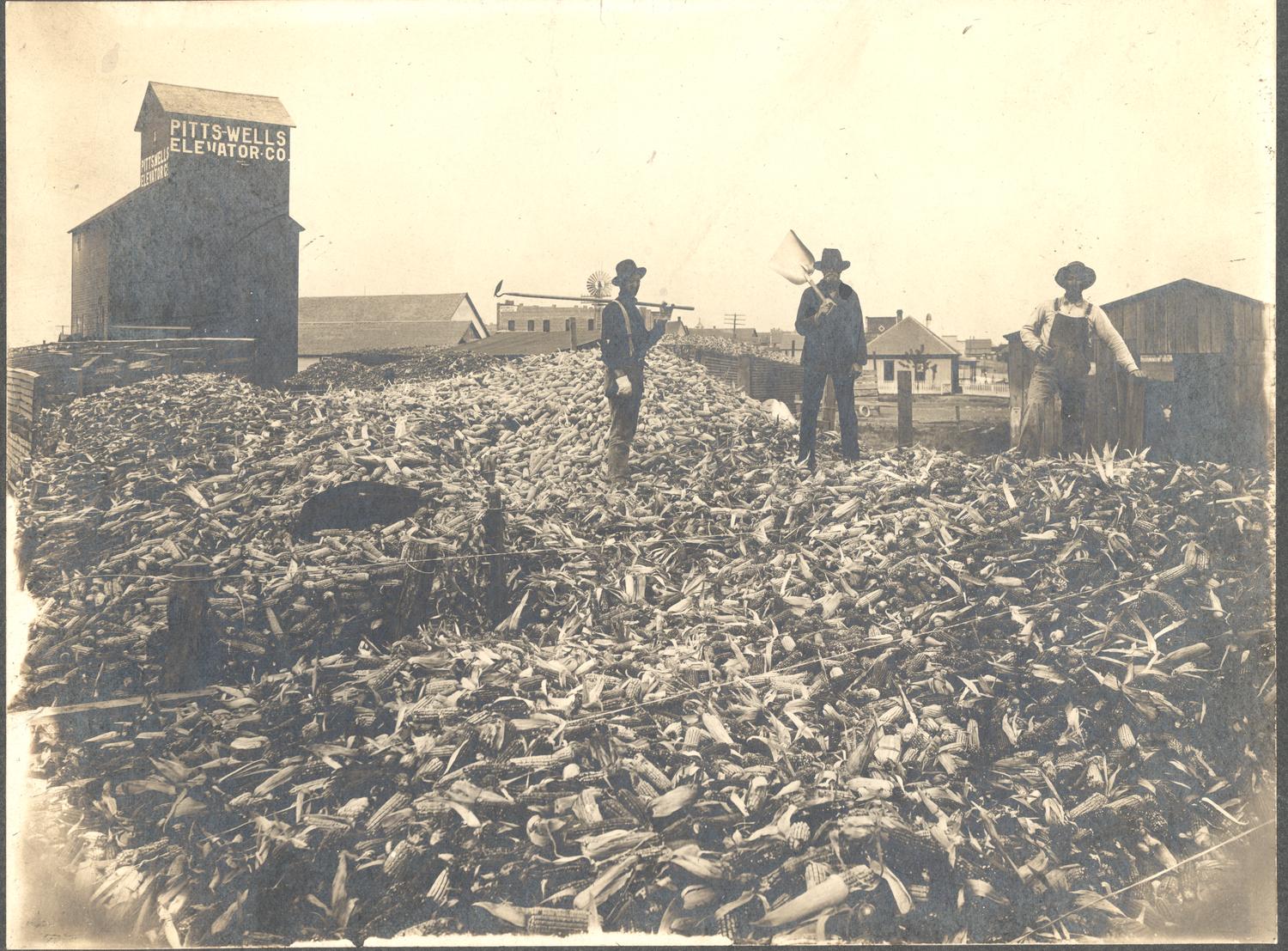
In 1907, three men posed with shovels on a pile of corn outside the Pitts-Wells Elevator Company. The ears rose above the sides of the wooden cribs. Behind them stood the elevator, its name painted in large letters near the roof, with houses and other buildings close by.
The Oklahoma Historical Society places the scene in Bartlesville. The town was growing rapidly around oil, railroads and new industries, but farmers still needed somewhere to sell their crops. A corn yard like this handled the harvest after it left the farm: storing it, preparing it for sale and getting it to buyers.
Why leave the corn on the cob?
The corn in the yard had been picked as whole ears. Kernels still covered the cobs, and loose husks lay among them. Before the grain could travel in bulk, someone had to shell it—separate the kernels from the cob—and move it through the business.
Storage mattered in the meantime. Corn held too wet could mold and spoil. Wooden cribs allowed air to move through ears of corn, helping them dry. There is more space for air between whole ears than between loose kernels; as the University of Minnesota’s agricultural extension explains, shelled corn offers greater resistance to airflow.
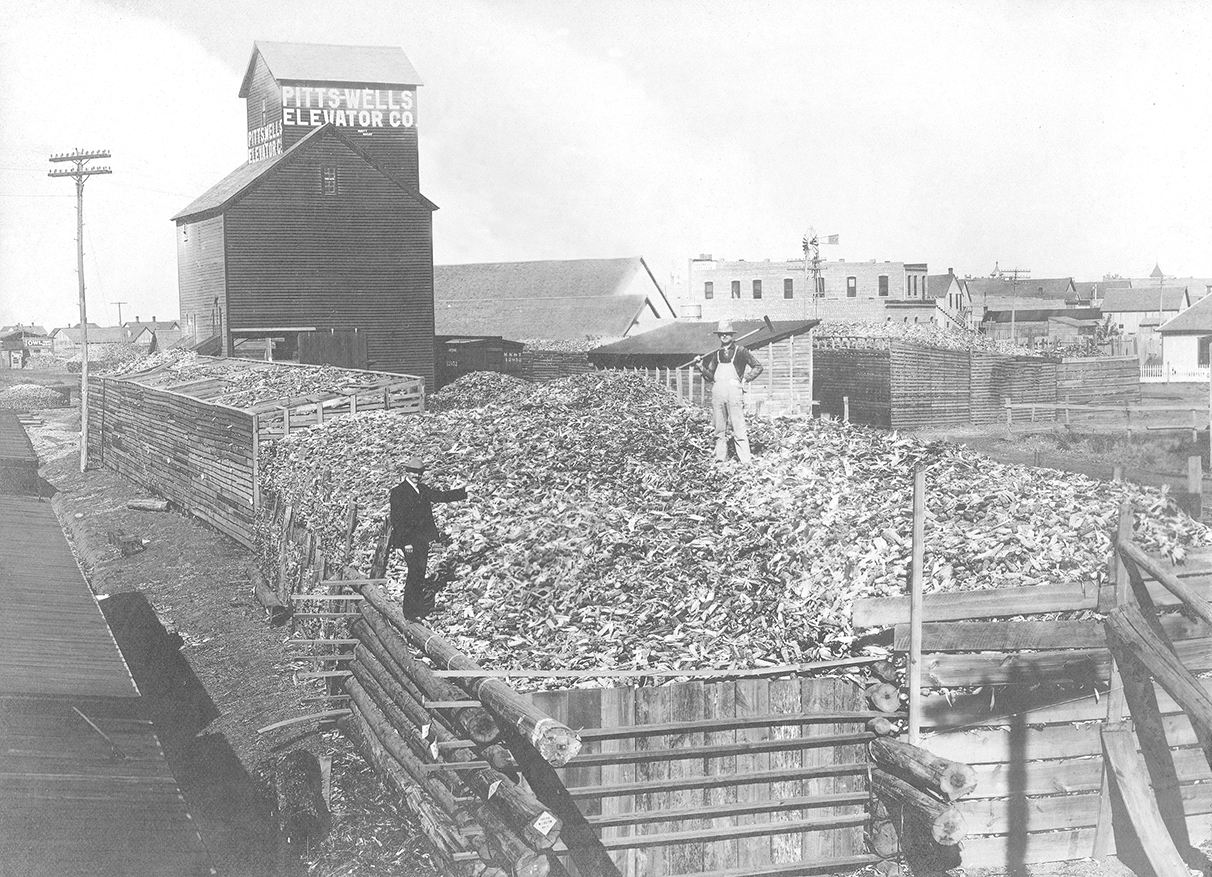
The second photograph gives a better view of the yard’s arrangement. Corn fills several separate cribs around the elevator. A man stands on one pile, another beside the fence, and a railroad car is visible behind the building. The equipment and storage occupied a substantial piece of town, with a windmill and a two-story building immediately beyond the yard.
What did an elevator company actually do?
A country grain elevator was a receiving point between farmers and larger markets. It gathered grain from individual deliveries so it could be stored and shipped in quantity. The tall building housed the lifting operation: grain went up, then gravity carried it down toward storage or railroad cars bound for mills and distributors.
That explains the name. The “elevator” was part of the machinery for moving the crop, and the word also came to mean the business and its buildings.
Early Oklahoma elevators were commonly wooden structures. Some used thick planks laid flat and spiked together; others used framed walls reinforced with steel rods. The enormous concrete elevators familiar along Oklahoma railroads became more common beginning in the 1920s. The Pitts-Wells photographs show the earlier wooden kind, surrounded by outdoor storage.
Bartlesville had a market before it had an oil boom
The town’s milling business began well before the oil wells. Nelson F. Carr built a gristmill along the Caney River in 1870. Jacob Bartles bought it in 1875, adapted it to grind flour and added a general store. A blacksmith shop, livery stable and lodging followed.
The railroad changed where business happened. When the Santa Fe reached Bartlesville in 1899, its route favored the settlement south of the Caney River. Bartles moved his establishment north and founded Dewey. Missouri, Kansas and Texas Railway service followed in 1903.
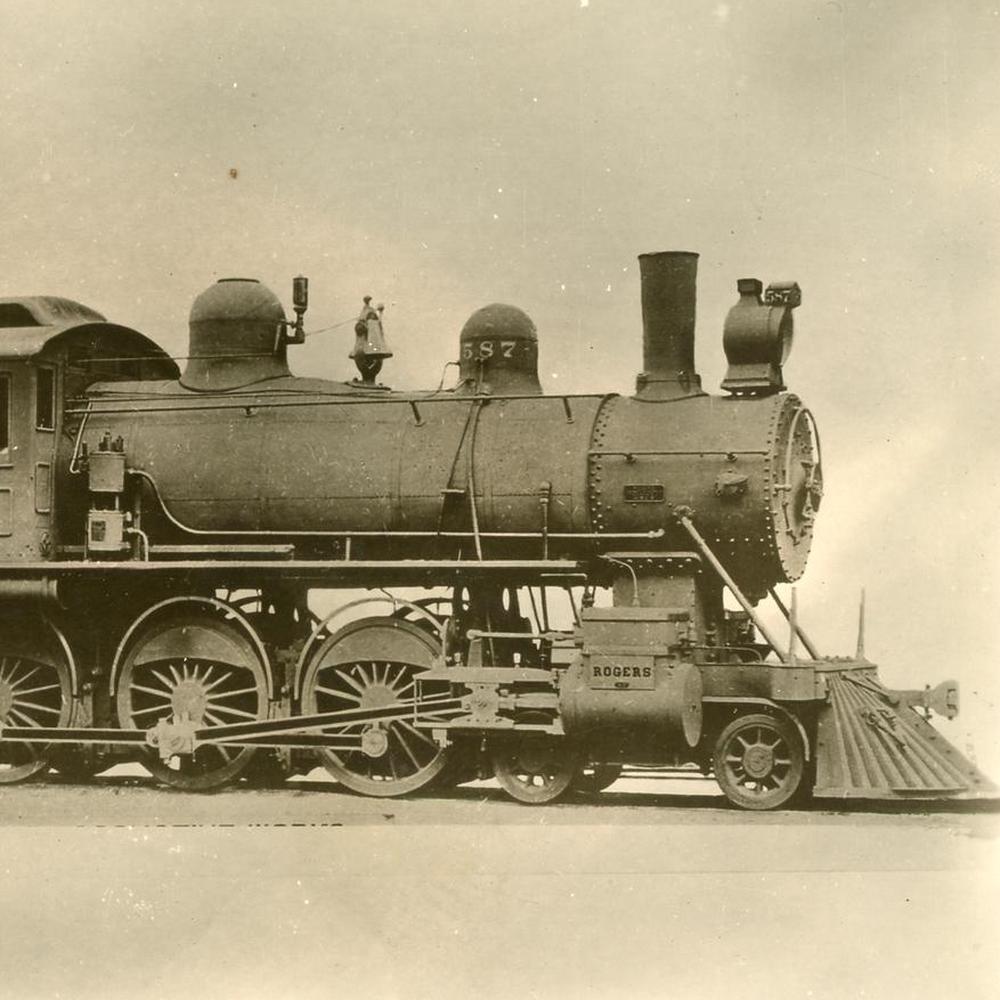
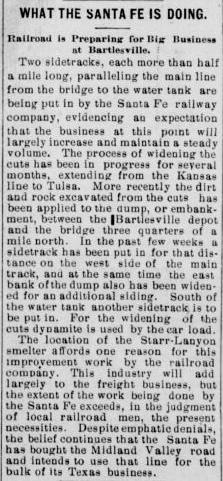
By January 1907, the Santa Fe was adding sidetracks to handle more business. The local Weekly Examiner reported work on two sidings, each more than half a mile long, between the bridge and the water tank. Crews were widening cuts along the line and using excavated material to build up the embankment near the depot.
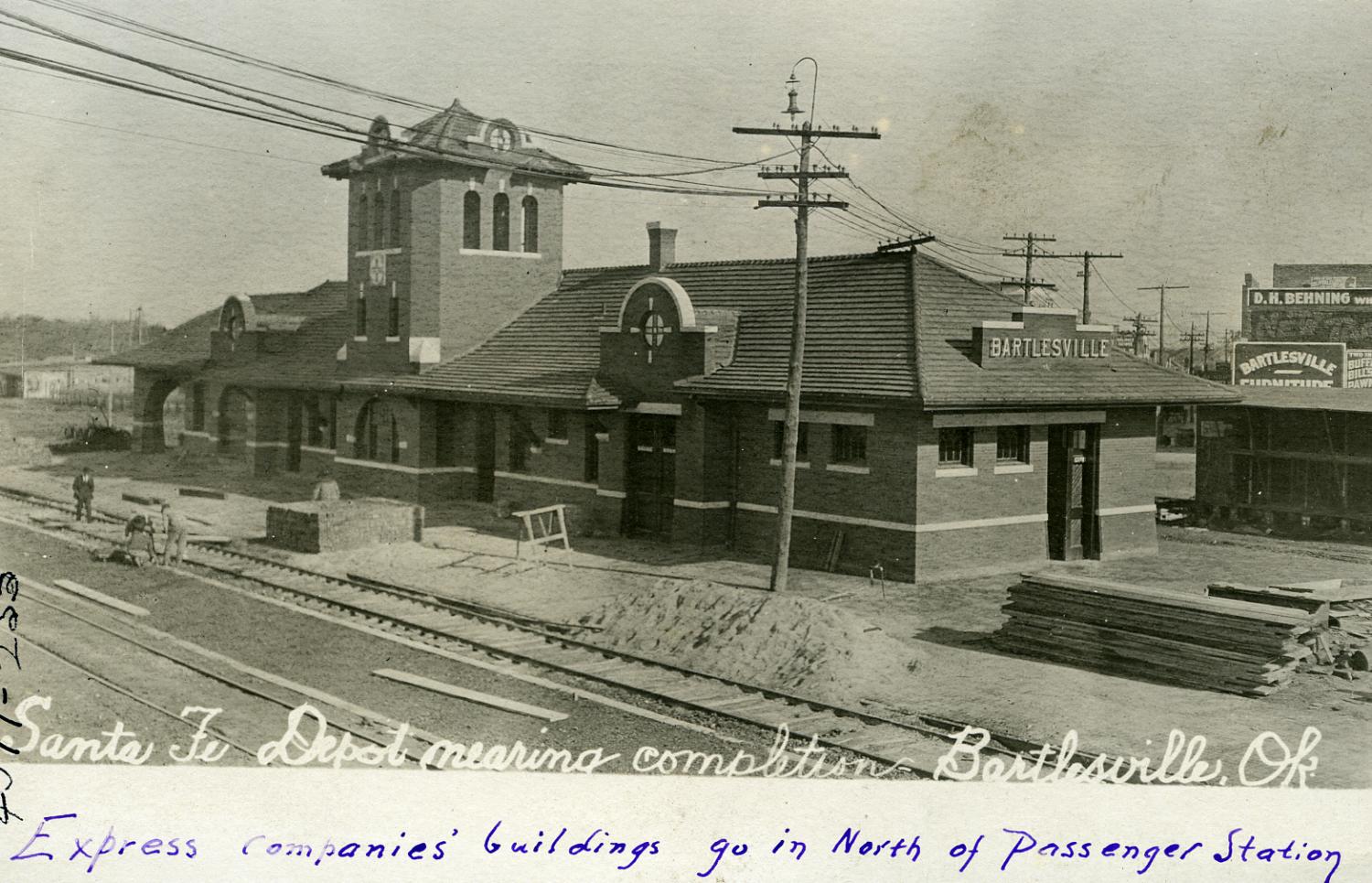
The depot photograph shows the town around that railroad: tracks in the foreground, lumber stacked beside them, and businesses behind the passenger station. Farm crops shared this expanding transportation network with the oil and manufacturing businesses drawing people into Bartlesville.
Pitts-Wells in Broken Arrow and Ketchum
Later grain-trade reports place Pitts-Wells operations elsewhere in northeastern Oklahoma. In August 1922, The American Elevator and Grain Trade reported that the Pitts-Wells Grain Company of Broken Arrow planned to build an elevator at Ketchum. It would replace the Spradin elevator, which had burned about a year earlier.
In December 1924, the same publication reported the sale of the Pitts-Wells elevator at Broken Arrow. A. C. Hayes had bought it from W. J. S. Bower. Dick Morrow would manage it, and the elevator would continue under the Pitts-Wells name.
Our corn harvest fit on a towel
We have tried a very small version of the harvesting-and-shelling job ourselves. We planted red and blue popcorn kernels from a bulk bag bought at WinCo, grew them in our Oklahoma backyard, picked the ears and shelled them by hand.
The resulting pile fit on a towel. Getting even that much corn off the cobs took time. Then came the stove test: some kernels popped, some puffed into little balls, and a fair amount was not especially edible. We had grown the corn, but we still had drying and preparation to figure out.
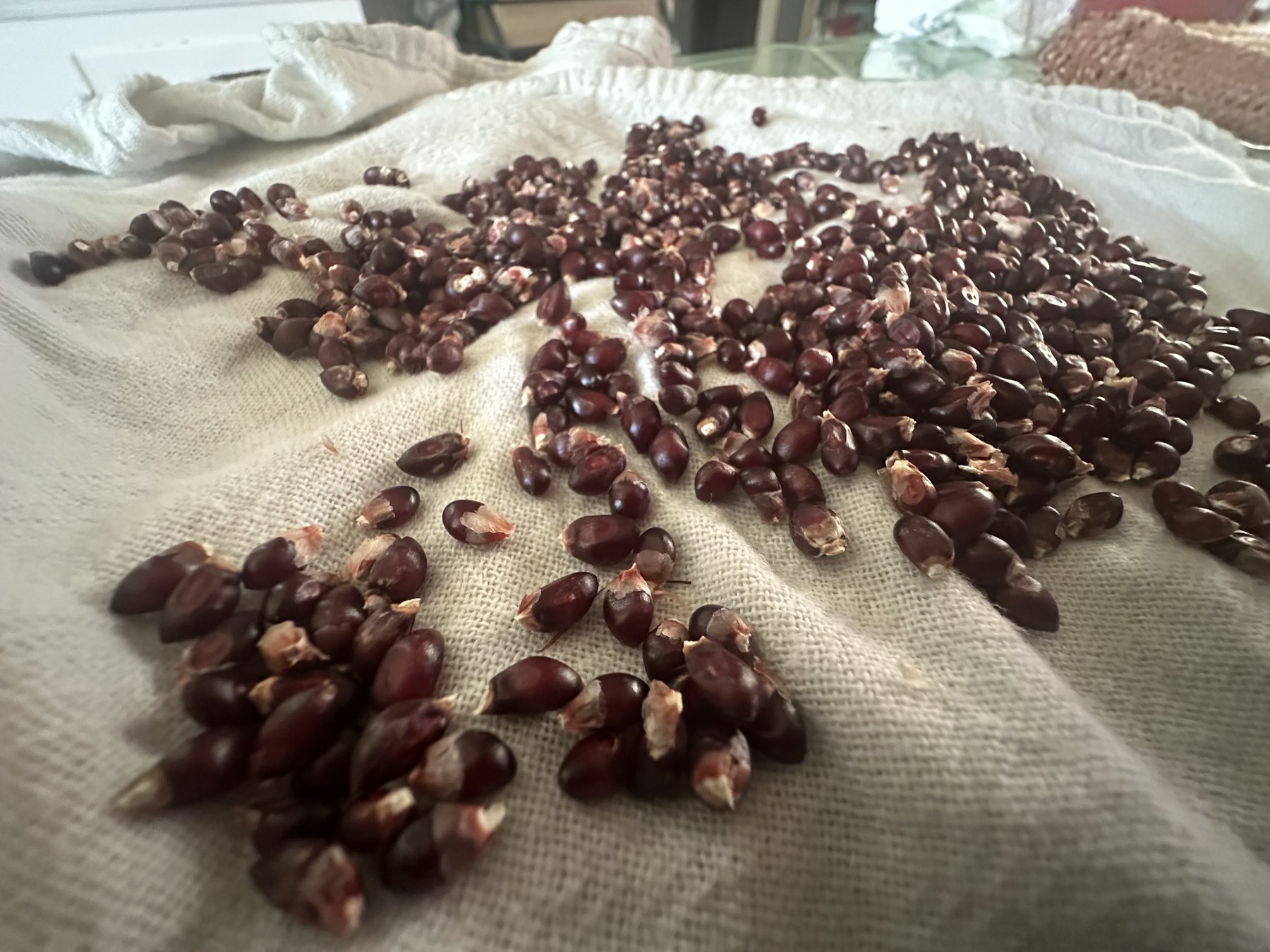
The corn variety in the Pitts-Wells photographs is unidentified. Our batch was popcorn, and you can watch the experiment and read how it went in Making Popcorn from Corn Grown in Our Backyard.
Sources & image credits
- Corn crop at Pitt-Wells Elevator Company, 1907; Oklahoma Historical Society photograph
- Pitts-Wells Elevator, MLSOK0399; Metropolitan Library System of Oklahoma County
- W. David Baird, “Grain Elevators,” Encyclopedia of Oklahoma History and Culture
- “Bartlesville,” Encyclopedia of Oklahoma History and Culture
- University of Minnesota Extension, “Natural-air corn drying” (ear-corn cribs and airflow)
- The Weekly Examiner, January 12, 1907, page 1, “What the Santa Fe Is Doing”
- Santa Fe Depot, Oscar Drum, circa 1907–1908; Oklahoma Historical Society photograph
- The American Elevator and Grain Trade, August 15, 1922, p. 125 (PDF page 55), Pitts-Wells Grain Company at Ketchum
- The American Elevator and Grain Trade, December 15, 1924, p. 431 (PDF page 57), sale of the Broken Arrow Pitts-Wells elevator
- Okie Almanac, “Making Popcorn from Corn Grown in Our Backyard”
Corn outside the Pitts-Wells elevator, cataloged by the Oklahoma Historical Society as Bartlesville, 1907. Courtesy Oklahoma Historical Society, Gateway to Oklahoma History. Pitts-Wells elevator and corn cribs. The library dates this view to 1900. Courtesy of Metropolitan Library System of Oklahoma County, MLSOK0399. Bartlesville’s Santa Fe depot around 1907–1908, photographed by Oscar Drum. Courtesy Oklahoma Historical Society, Gateway to Oklahoma History. The Weekly Examiner, January 12, 1907, page 1. This clipping describes railroad improvements at Bartlesville. Courtesy Oklahoma Historical Society, Gateway to Oklahoma History. Our own harvest, shelled by hand before the popcorn test. Photograph: Okie Almanac.