I’ve probably been to the old 45th Infantry Museum somewhere between 30 and 50 times over the past 20 years.

That sounds excessive until you remember one important detail: it was free.


When I was younger and didn’t have much money, that museum was one of my favorite places to spend an afternoon in Oklahoma City. You could wander the exhibits inside, then head outside and walk through the tanks, helicopters, artillery, trucks, and other military equipment like you had stumbled into the world’s most serious backyard collection.

Now the museum has a new home, a new official name, and a lot more room to tell the story.
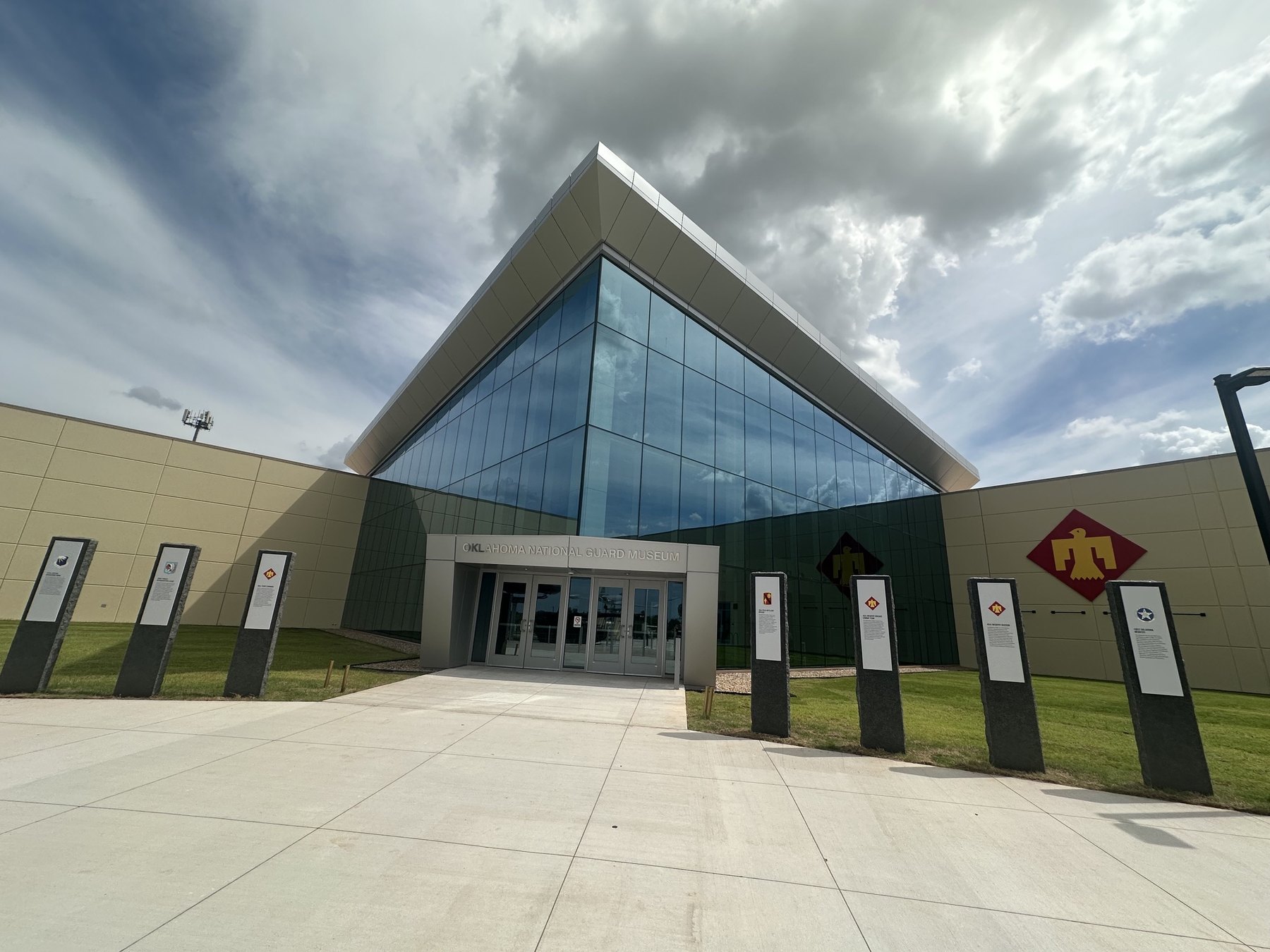
The Oklahoma National Guard Museum is now open at 3301 NE Grand Blvd., across Grand Boulevard from the Oklahoma Railway Museum. A lot of locals will still think of it as the 45th Infantry Museum, and that history is absolutely still there, but the new facility expands the focus to the broader story of the Oklahoma Army and Air National Guard.

It is a noticeable upgrade.
A bigger museum with better storytelling

The new building is spacious, modern, and much easier to move through than the old museum ever was. The facility opened to the public in June 2026 and includes expanded exhibit space, outdoor static displays, and an event and education center.
But the real improvement is not just size. It is pacing.

The old museum had a lot of artifacts, and I loved it for that. The new Oklahoma National Guard Museum does a better job explaining why those artifacts matter. The galleries are built more around stories than storage, which makes a difference when you are moving through heavy subjects like World War II, the 45th Infantry Division, and the liberation of Dachau.
There are still uniforms, weapons, photographs, documents, vehicles, and familiar pieces from the previous museum. I recognized quite a few things as I walked through. But the new setting gives them more breathing room, and in some cases, I noticed displays that either were new to me or had simply gotten lost in my memory over the years.

That is a good sign for a museum I already knew pretty well.
The World War II sections are the ones that pulled me in the most. They are not easy, exactly, but they are handled with enough care that you keep reading, looking, and connecting the pieces together.

The hands-on parts matter
One thing I appreciated is that the museum does not ask kids, or adults for that matter, to just stare at glass cases the whole time.
There are interactive displays scattered through the galleries, including one where you can pick up and feel the weight of a Thompson submachine gun, better known as the Tommy Gun. Another lets you try lifting a fully loaded military backpack.

Those are small moments, but they work.
Reading that a soldier carried a heavy pack is one thing. Putting your hands on the straps and trying to lift it gives your brain a different kind of information. It does not pretend to recreate the experience, but it does make the history feel less abstract.

That is especially helpful in a museum like this, where the subject matter can get sobering fast.
The outdoor military vehicles are still part of the draw, too. For longtime visitors, that is important. The tanks, artillery, aircraft, and other large equipment were a huge part of what made the old museum such a good free afternoon. The new museum keeps that sense of scale while making the indoor experience feel more complete.

The artifact I still think about
The exhibit that continues to stop me is the collection of artifacts described as having been recovered from Adolf Hitler’s bunker in Berlin.

Among them is a mirror said to have hung inside the bunker during Hitler’s final days. Standing in front of it is strange in a way that is hard to put neatly into a museum caption. You are looking at an object tied to one of the darkest endings of the 20th century, and the plainness of it is part of what makes it land.
It is not flashy. It is not large. It does not need to be.

It is the kind of artifact that makes the room get quiet around you.
That is where the new museum works best. It still has the big equipment and the military hardware, but it also gives space to personal objects, hard history, and the human cost behind the dates and campaigns.

The museum also includes space for future programs, lectures, and community events, which should make it more than a place people visit once and forget. That matters, especially for a museum trying to connect Oklahoma’s military history from territorial militia days through modern Guard missions and domestic responses.
If you visited the old 45th Infantry Museum, the new Oklahoma National Guard Museum is worth seeing. If you never made it to the old one, this is a strong place to start.

And admission is still free, which keeps it on my short list for an educational afternoon in Oklahoma City.
Details
- Address: 3301 NE Grand Blvd., Oklahoma City, OK 73111
- Phone: (572) 247-7470
- Hours: Tuesday-Saturday, 10 a.m.-5 p.m.; Sunday, 1-5 p.m.; closed Monday
- Website: https://www.okngmuseum.com/